So I had seven minutes on a Thursday night in Boulder, and twelve slides, and I was nervous.
This is that talk, written out. I have added the two pieces there was no room for on stage. One is what "solve the chaos first" looks like with a real client, because on the night it was a single line. The other is what happened after I stepped off the stage, which turned out to be the part I keep thinking about.
Who I am.
Hi, I'm Eleah. I'm an AI systems architect, which really just means I'm an ultimate generalist who understands systems well, and the nervous system too.
My background runs from marketing to business development to software engineering to design, and for the last five years, somatic healing, nervous system research, and ADHD. Over the last nine months I have kind of become a fractional head of systems for a handful of business owners with neurodivergent brains. My job is to keep them in their zone of genius and automate the rest.
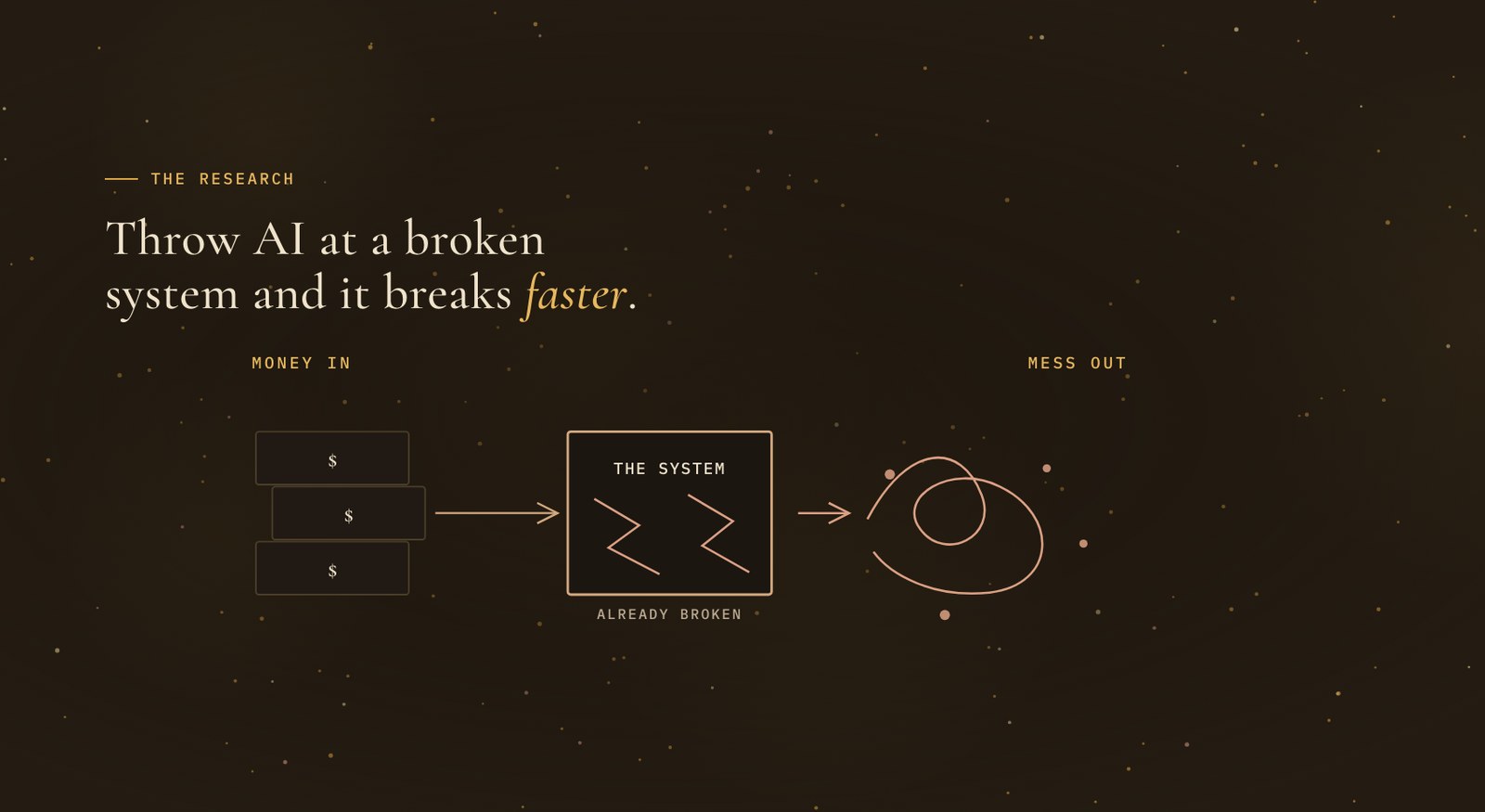
The money going in, the mess coming out.
I don't know if you have seen the research, but there was a study, I think MIT did it, on large companies that have poured tons of money into AI and have yet to see a return.
I believe it is because the systems themselves are broken. When you throw AI at a broken system, it breaks really, really fast, and it makes a big mess.
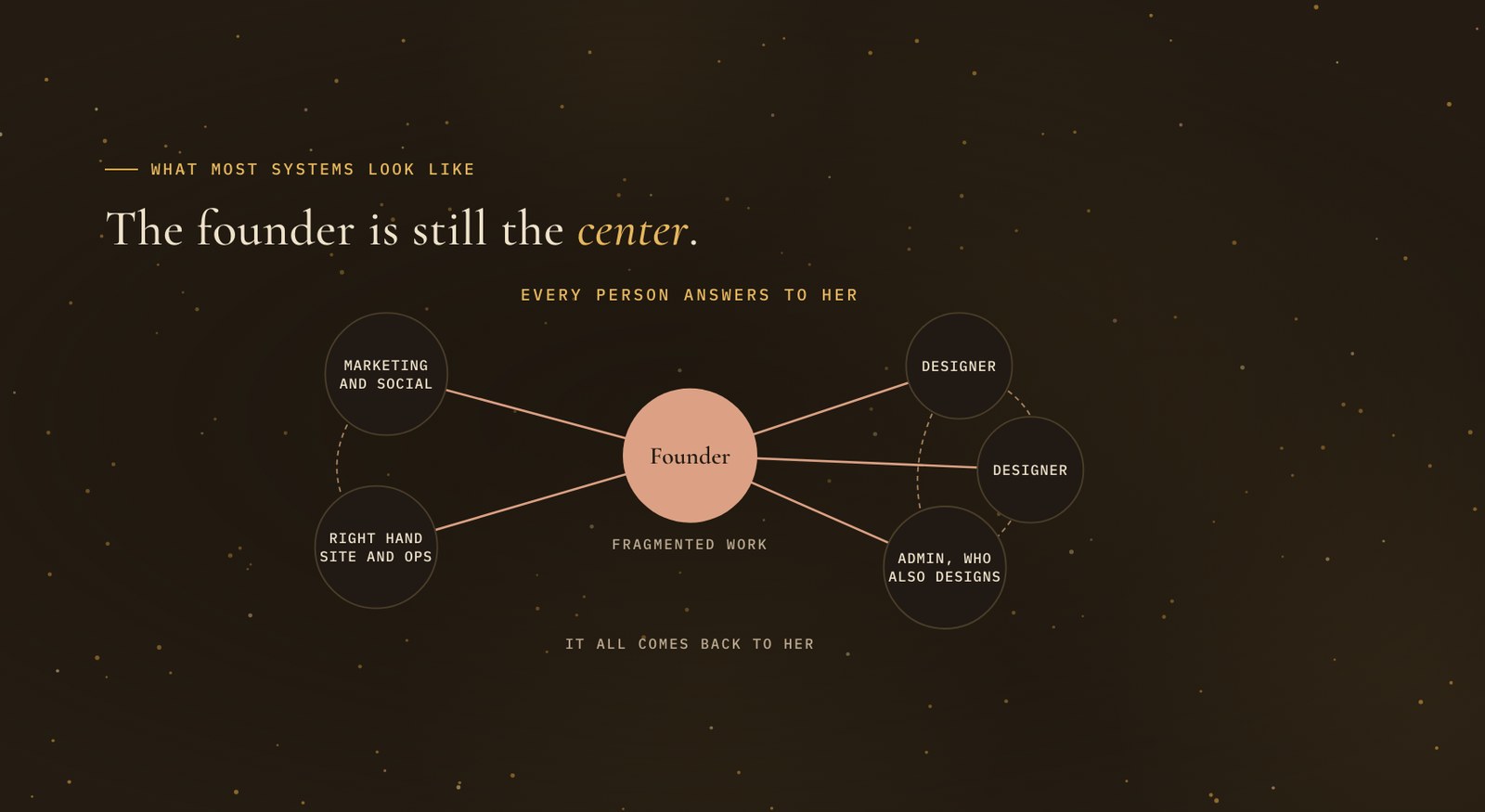
What most systems look like right now.
Most of my clients are small businesses or solopreneurs. The ones that have been around a while have a team, a human team. But the founder is still the center.
Every person answers to her. They are doing fragmented work that all comes back to her. So no matter how cool of an AI system I build her, if her team is not using it, it is not going to help much.
Where I learned this.
The first job I ever had, in college, they put me in charge of the billing department and the marketing department of a home security company. The owner would just say, "Leah, you're the boss. Figure it out." And he would hand me stacks of books. Good to Great. Seven Habits. How to Win Friends and Influence People. Kind of before my time, but the principles hold.
If a company depends on one person, it is fragile. You teach people to run the business when you are not there.
The one that stuck, from Jim Collins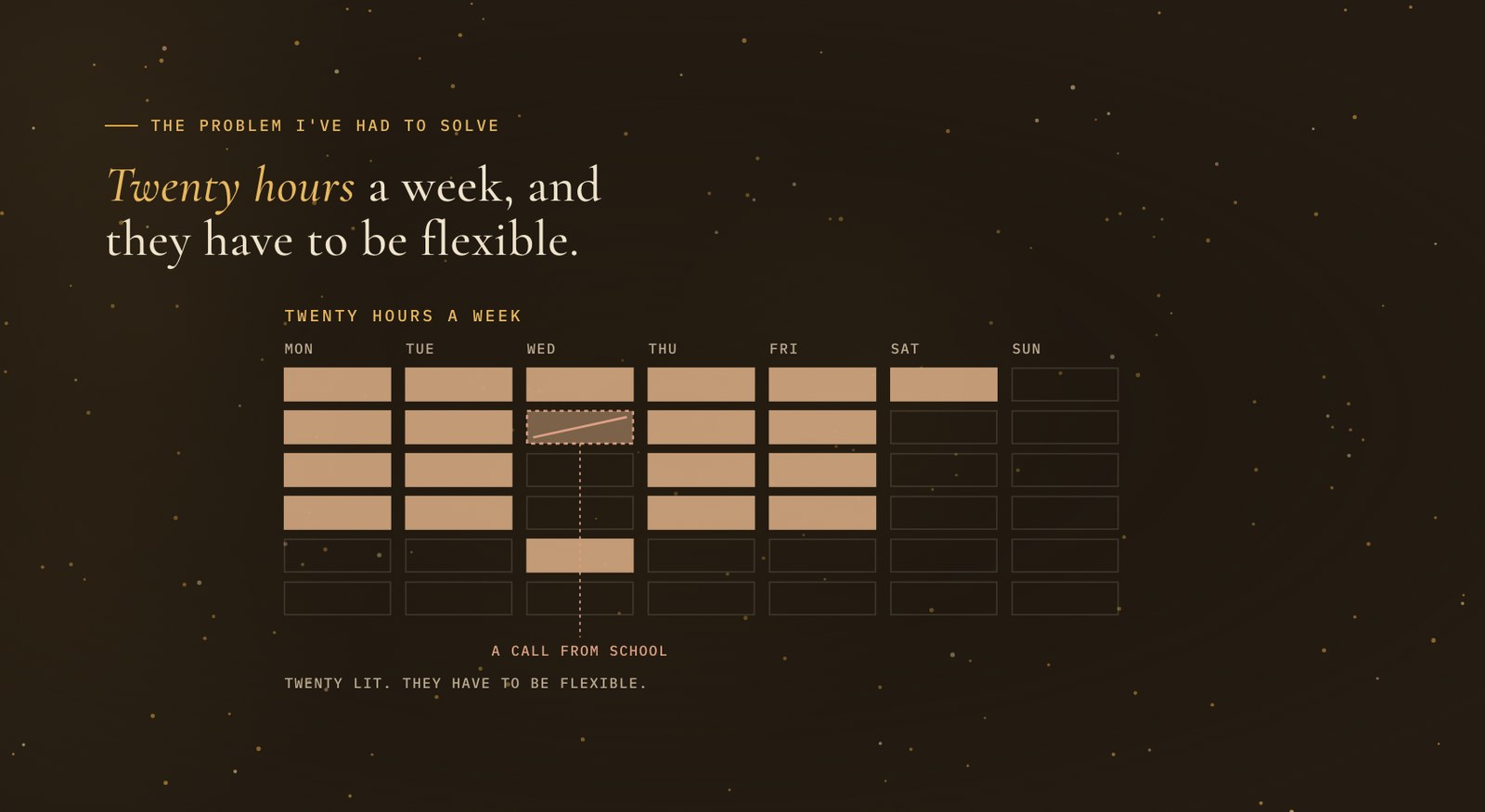
The problem I had to solve.
I'm a solo mom and the primary breadwinner for a family of five. I have about twenty hours a week that I know I can work, and those hours have to be flexible, because at any moment I could get a call from my son's school. I pause, and I pick it up later.
At first that felt impossible.
But lately my systems have started to work. I'm teaching pieces of my business to run without me. When somebody in my house has a sick day, my projects still move. Instead of seeing that as a weakness, I'm starting to see it as a superpower. If a system can support a family of five on twenty hours a week, then the weeks I have more time, it compounds.
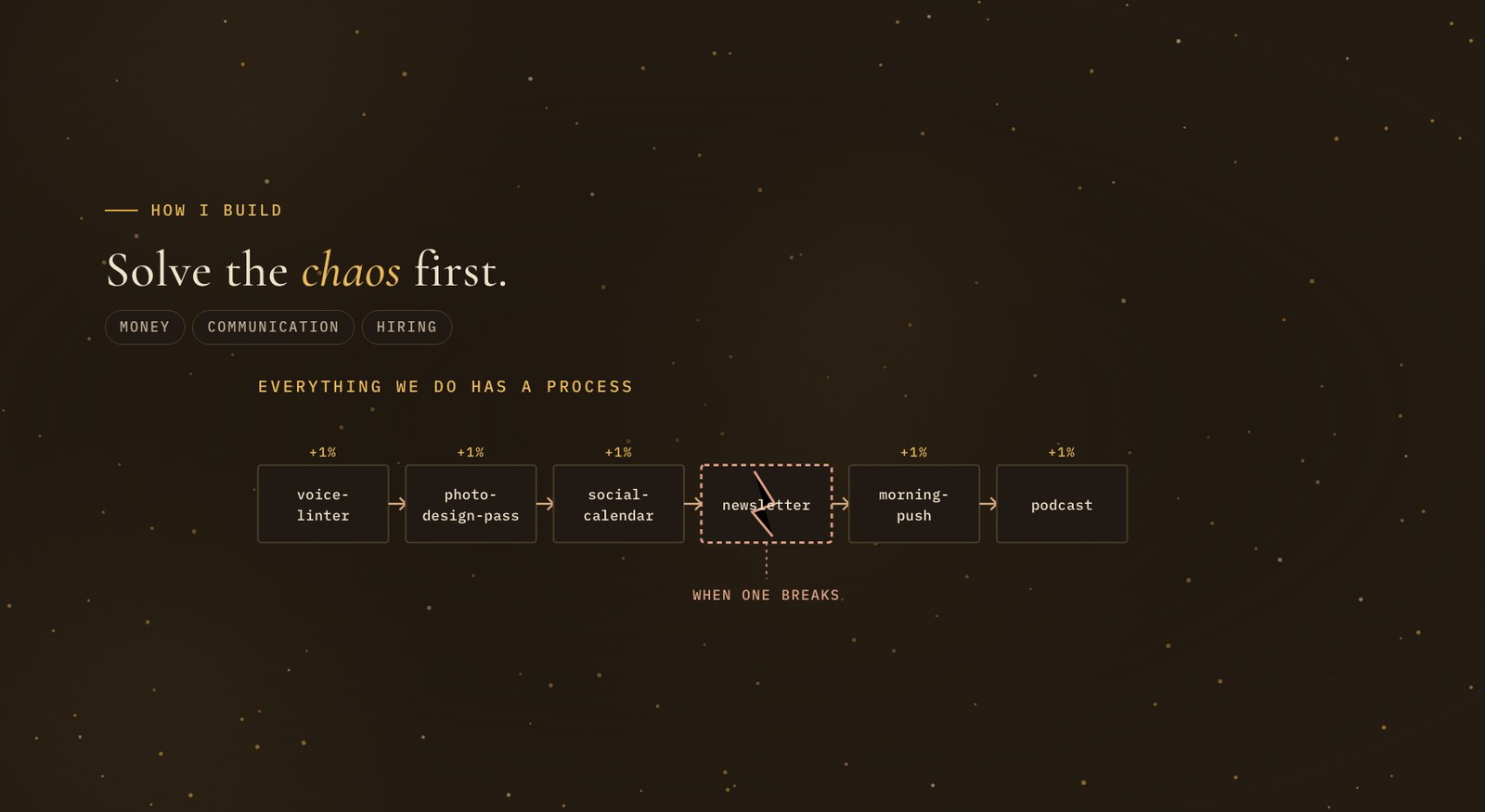
Solve the chaos first.
A lot of my clients have brains like mine. Almost every one of them feels like they are in chaos right now.
So I build slowly, on purpose. I go after whatever is causing the chaos first. Most of the time the biggest stressor is money, so we go after the revenue-driving work first. Sometimes it is communication. Sometimes it is needing to hire the right person.
Everything we do has a process, and each piece gets one percent better every time I touch it. I took that from James Clear. You cannot solve your other problems until you solve the chaos. If your nervous system is activated, your work is going to be far worse than when you are calm.
What that looked like with one client
A founder came to me wanting a command center. One dashboard with her email stats, her site analytics, her membership numbers by tier, and her team's hours, all in one place. It was a good idea, I think. I wrote the proposal, built it as a live page in her brand, and priced it.
Then on the call she told me the dashboard was a pet dream.
What was actually happening underneath: she had spent her savings on her team that year. She was loaning her own salary back to the business. She had paid one contractor around five thousand dollars for maybe a thousand dollars of load-bearing work. And she had no visibility into anyone's hours, which is exactly why she wanted the dashboard in the first place. But the dashboard was weeks of building away from the leak.
So we moved. The first thing I'm doing for her is the broken-things list on her platform, priced at the same hourly rate her developers charge. I'm reviewing it from her actual code rather than from the titles on her tickets. The second is a consolidation she did the math on herself, out loud, while we were talking. Three subscription tools plus a person moving recordings by hand. About a thousand dollars a year, plus the hours.
The dashboard is still on the list. It is just not first.
That is what going after the chaos means in practice, and it is usually less fun than it sounds. Most of the time it means telling a client that the pretty thing waits.
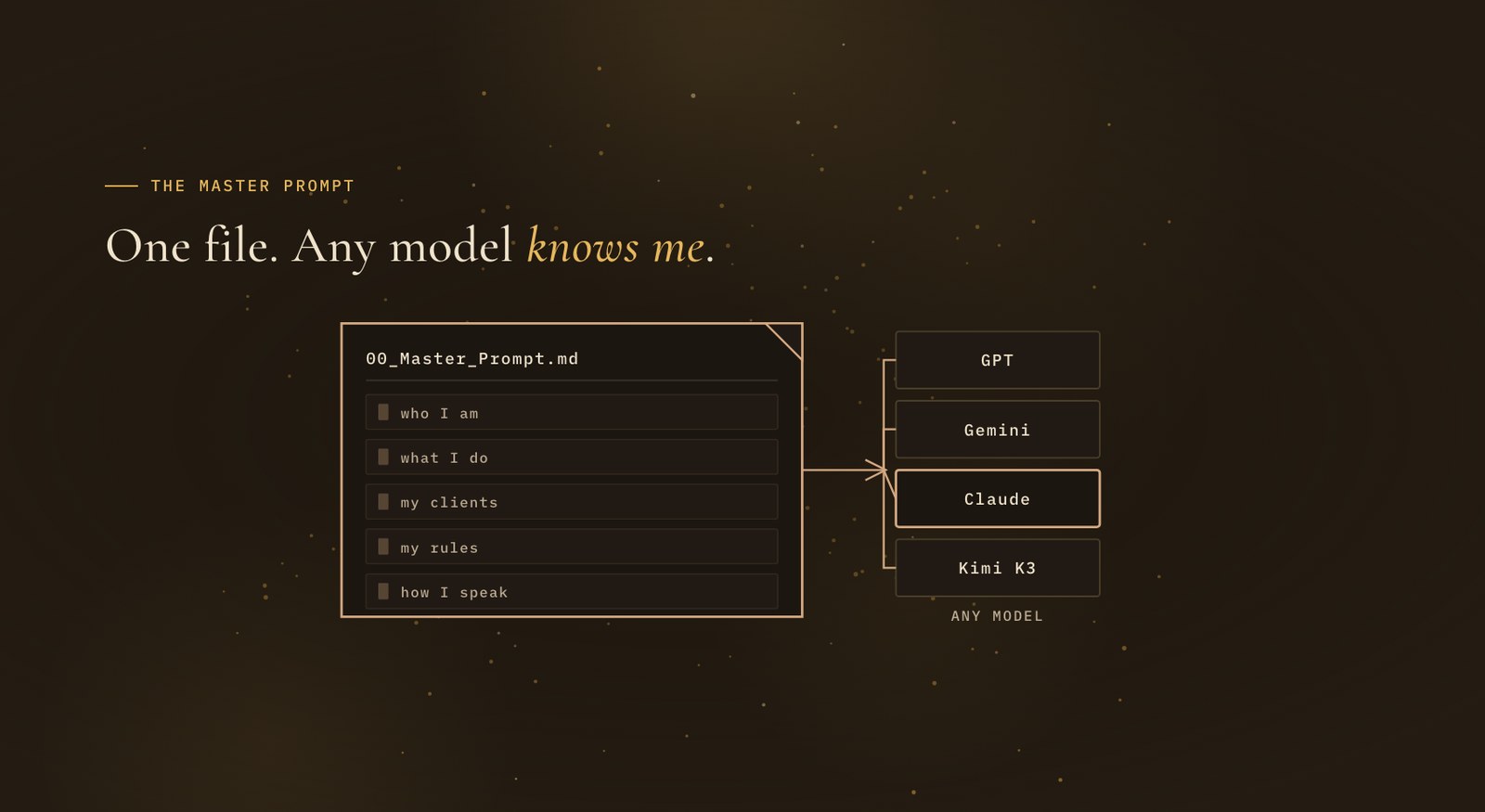
The master prompt.
So this is the shape of the system I built for myself. It starts with a master prompt.
Everything about who I am, what I do, who my clients are, the rules I will and will not break, how I speak, all in one markdown file on my computer. I can hand it to any AI model and it immediately knows me.
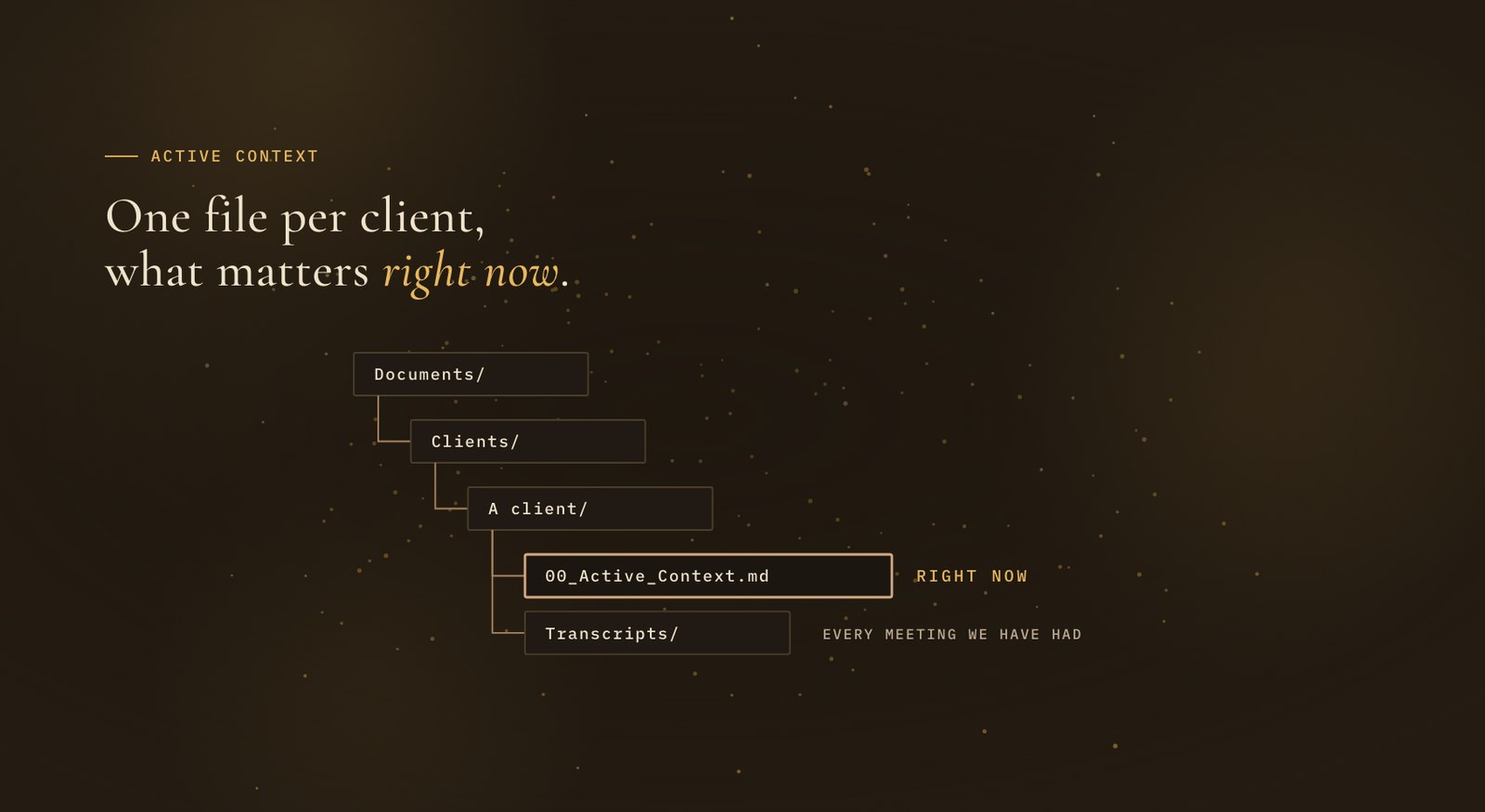
Active context.
Then there is an active context file. Every client has one file that holds exactly what matters for them right now, and next to it, the transcripts from every meeting we have had.
So I remember everything they want and need from me.
This is the shape of the two files everything else hangs off. Make the master prompt first, then one active context file per client. Keep them short enough that you will actually update them. If a section feels hard to write, that is the section your team has been guessing at.
00_Master_Prompt.md
-------------------
# Who I am
# What I do, and who I do it for
# My clients, one line each
# Rules I will not break
# How I speak, and what I never say
# What "done" looks like to me

Clients/<Name>/00_Active_Context.md
-----------------------------------
# Where we are right now
# What they asked for, in their words
# Decisions already made, dated
# Open questions I owe them
# What I am not doing yet, and why
# Transcripts: ./transcripts/YYYY-MM-DD.md
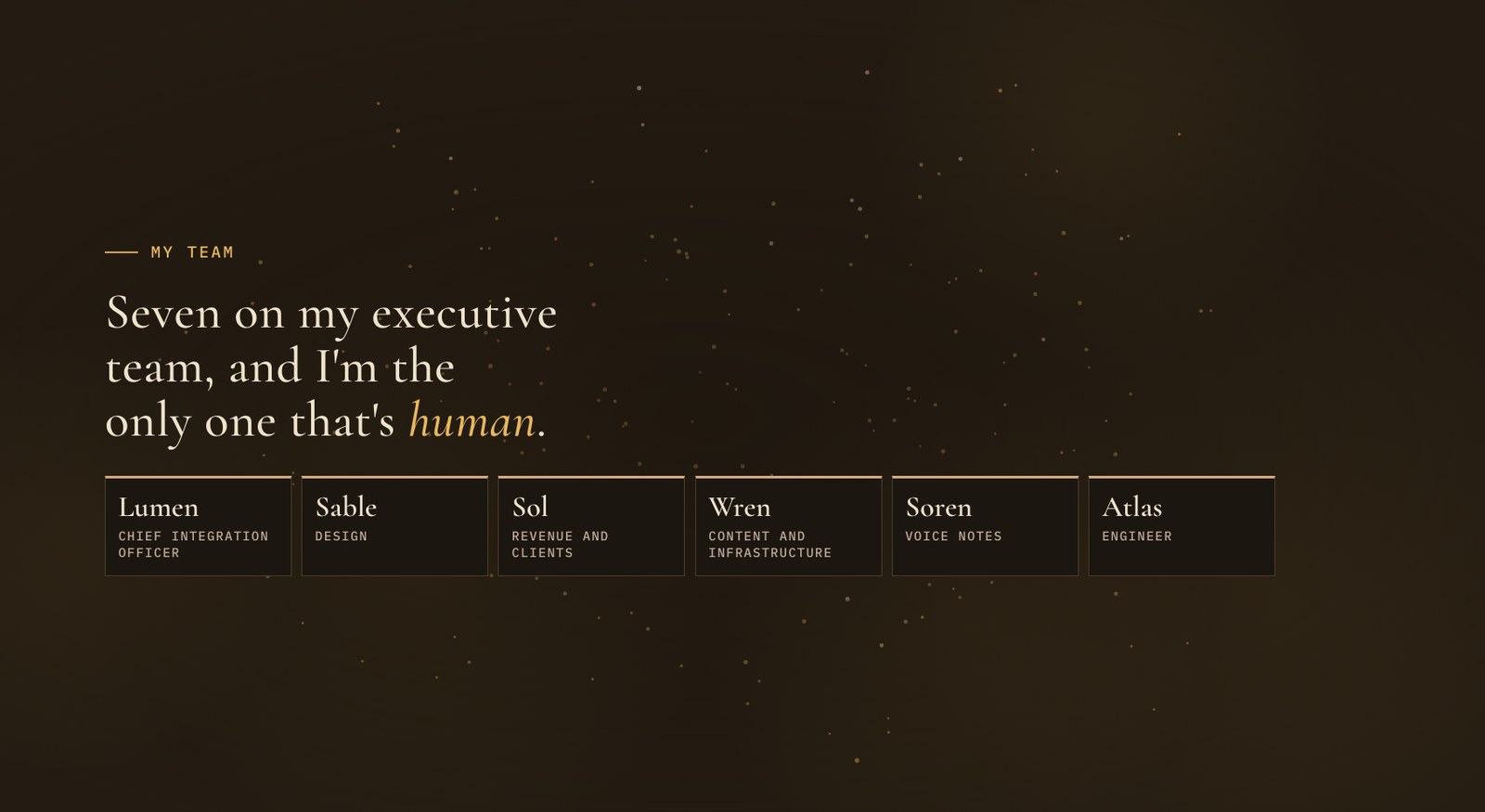
My team.
And then there is my team. I always tell people I have seven on my executive team, and I'm the only one that is human.
Lumen is my chief integration officer and oversees everyone. Sable does design. Sol runs revenue and clients. Wren does content and infrastructure. Soren handles my voice notes, and Atlas is my Claude Code engineer, the one I have been working with most lately.
Inside each process, I have set up skills that teach the team exactly how I want something done. And I manage them by talking. I dictate from the gym, on a walk between calls, in the car. Every morning I do my morning pages and give the team feedback.
I'm kind of all in on letting AI support what I'm trying to do in my life, because I really need it.
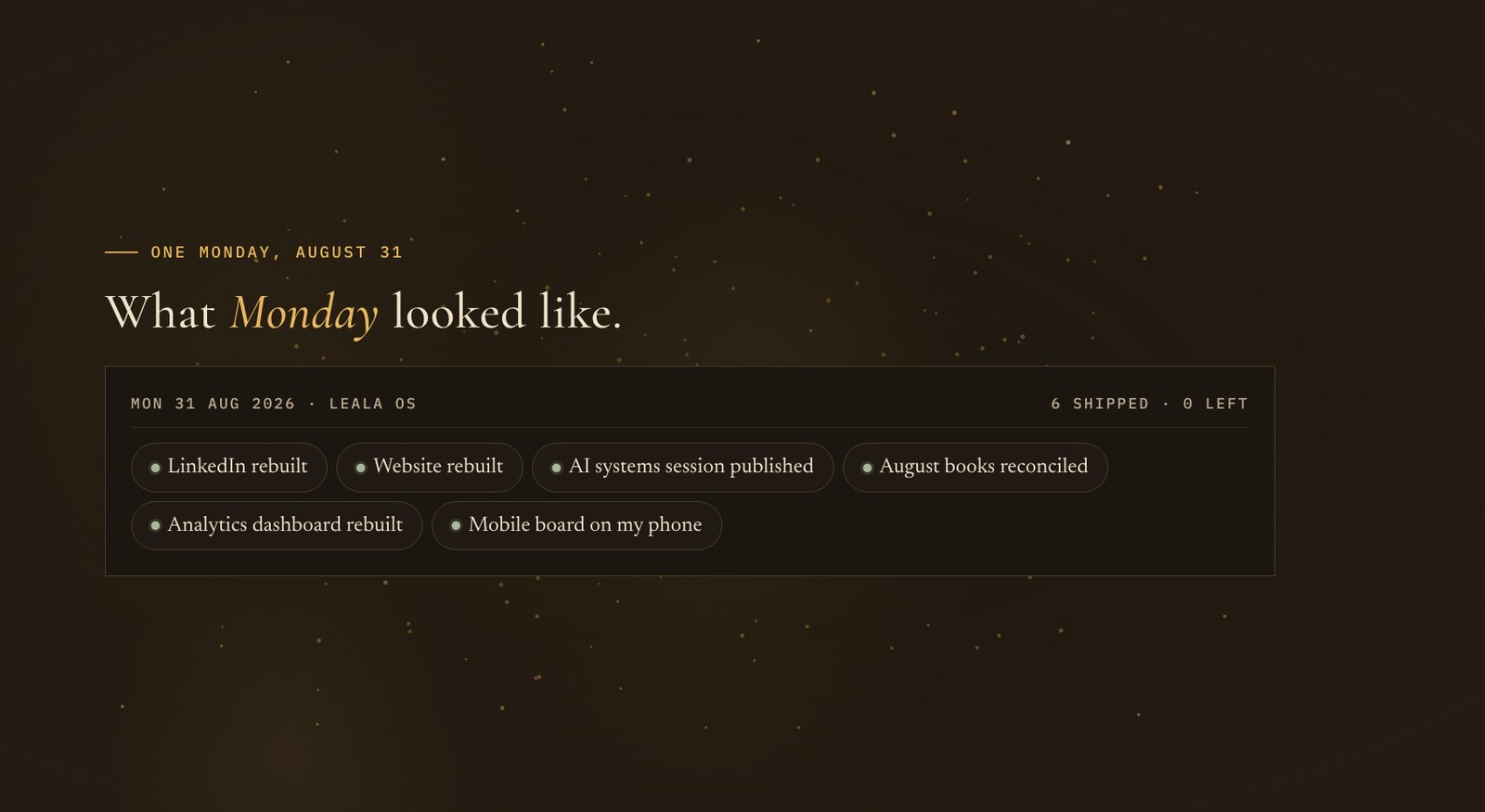
What Monday looked like.
I rebuilt my LinkedIn top to bottom. I rebuilt my website top to bottom. An AI systems session got published. My August books got reconciled, which is my least favorite part. My analytics dashboard got rebuilt, and I got a mobile version of that board so I can see it on my phone.
That was one Monday.
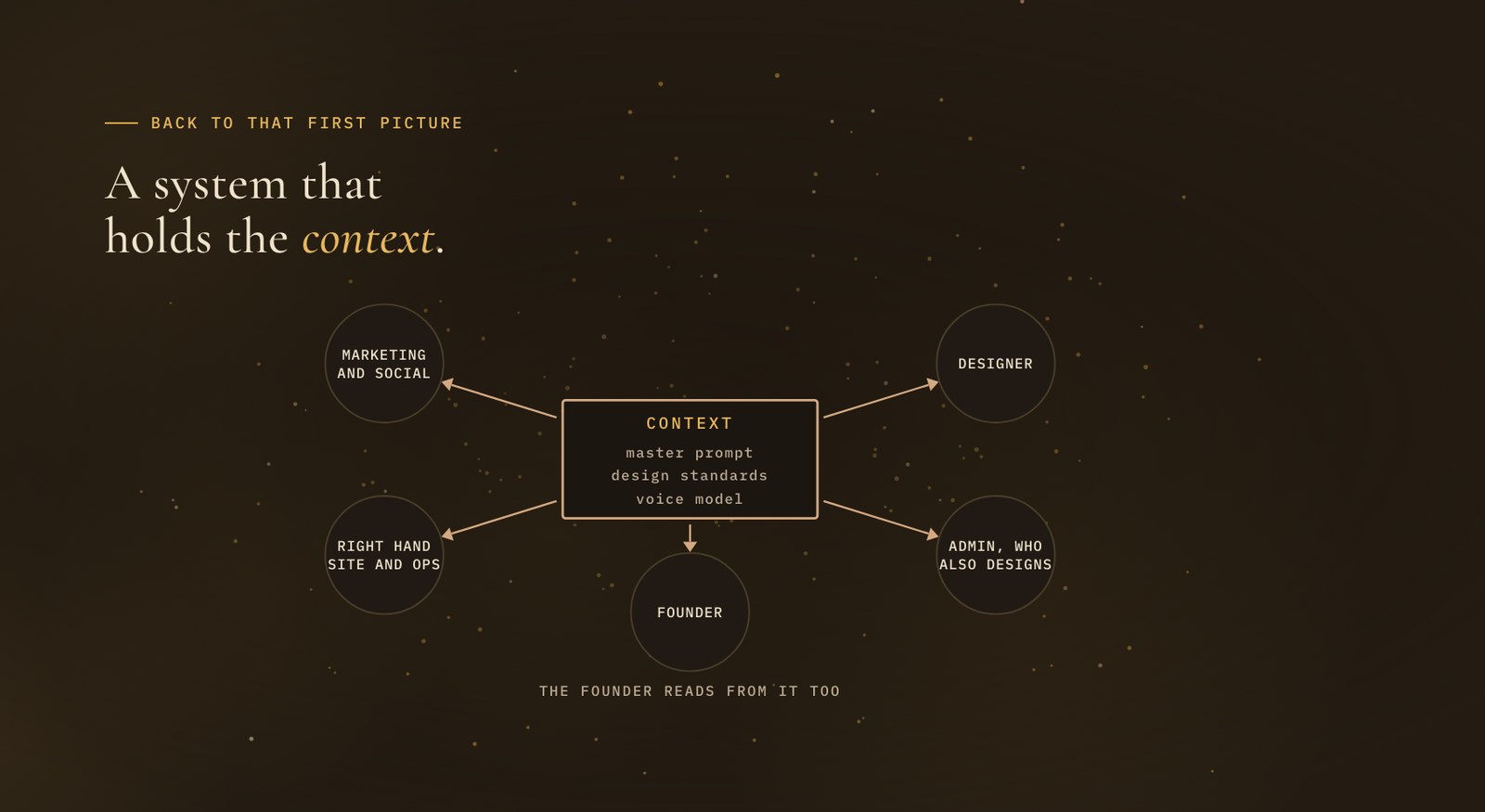
Back to that picture of the founder in the middle.
What I'm building for my clients is a system that holds the context, so the founder is not the only one holding it.
When the master prompt, the client files, and the team all point at the same place, the work keeps moving when she steps away. I think that is what running without me means.
How women are building.
This is how women are building systems in the era of AI.
I have found it fascinating to watch the difference between how men and women are building right now, and I think more women need to be talking about it. If you want help building yours, that is what I do.
What happened after.
I said thank you and stepped off, and then there was a line of people.
People wanting to do work with me. Women wanting to connect and collaborate. A lot of people asking how I made the slides, and how I made the website, and what skills I used. Which was funny, because my honest answer is that a lot of it is my vision for things.
One woman said I had put into words a lot of the things she had been thinking about and could not find the words for. And then she thanked me. I'm still a little bit undone by that one.
The thing I keep coming back to is older than the talk. For years I tried to be myself and got rejected for jobs over it. I think people could always just see it: oh, you're an entrepreneur, and we want you to do this one narrow thing. I kind of would have loved a boring job for some time. And then I stood in a room in Boulder. The exact quality that got me passed over was the thing people lined up to talk about.
I was not wearing my recorder, which I regret, so this is the version I have.
If you want help building yours, I'm at leala.co/book.